QiFi Journal
Coffee prices fall as the new crop arrives: why, and where Vietnam stands
The world is heading for its largest coffee crop on record and prices are down about a quarter. Why, who Vietnam competes with, and what changes in your cup.
QiFi··5 min read
Contents
After several years of rising coffee prices, this autumn's news runs the other way. According to the US Department of Agriculture (USDA), world coffee prices have fallen about 25% in 7 months, and the 2026/27 crop is forecast to be the largest ever. At the same moment, the Central Highlands are starting the harvest. This article explains why prices are falling, who Vietnamese coffee competes with, and what it means for the cup you drink every morning.
What does coffee cost today?
Domestic prices and prices on the two world exchanges, according to giacaphe.com on 14 October 2026:
| Price | Level | Change on the previous session |
|---|---|---|
| Central Highlands green coffee (average) | 93,000 VND/kg | −200 VND |
| Robusta, London, November 2026 contract | 3,459 USD/tonne | −19 USD |
| Arabica, New York, December 2026 contract | 292.70 cents/lb | +2.10 cents |
The two exchanges use different units. Converted to the same unit, 292.70 cents/lb is about 6,450 USD/tonne, so Arabica costs almost twice as much as Robusta. Prices change every session, so this table is a snapshot of one day.
Why are coffee prices falling?
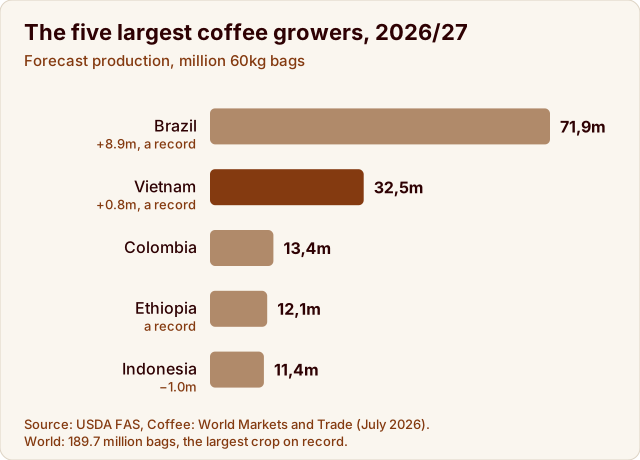
The short answer: the world is about to have more coffee. USDA's July 2026 report forecasts the 2026/27 crop at 189.7 million 60kg bags, up 10.8 million bags on the previous year and the highest ever. Four countries are set for records at once: Brazil, Ethiopia, Uganda and Vietnam.
Three things are pulling prices down at the same time:
- Brazil is bouncing back. After five years of weather-hit Arabica crops, Brazil is forecast to harvest 71.9 million bags, up 8.9 million, almost all of the increase in Arabica. Brazil's season is covered in detail in the 2026 Dak Lak coffee harvest.
- Stocks are filling up. The world's ending coffee stocks fell by 15.5 million bags between 2020/21 and 2024/25. Now they are rising for a second year running, to 26.3 million bags. The fuller the warehouses, the less hurry buyers are in.
- More beans are being exported. USDA forecasts world bean exports at a record 131.4 million bags.
Demand is not falling: the world is forecast to drink a record 179.7 million bags, with the strongest growth in Europe and the United States. Prices are falling because supply is growing faster, not because people are drinking less coffee.
Who does Vietnamese coffee compete with?
Vietnam is the world's second-largest coffee producer, and almost all of it is Robusta. In Robusta, the main rivals are Brazil, Indonesia and Uganda. In Arabica, the territory of Brazil, Colombia and Ethiopia, Vietnam accounts for only about 1% of production. How Vietnam's two beans compare with the world on price, taste, caffeine and competitiveness is in where Vietnamese Robusta and Arabica stand on the world map.
Vietnam's 2026/27 crop: a record 32.5 million bags
USDA forecasts Vietnam's crop at 32.5 million bags, up 800,000 bags and the highest ever. The reason given is very down to earth: more planted area and higher yields, because the recent years of high prices gave farmers the money to fertilise and look after their trees better. The previous crop was also revised up to 31.7 million bags.
Two other figures stand out:
- Bean exports are expected to reach 25.4 million bags.
- Vietnamese people are drinking more coffee than ever: domestic consumption is forecast at a record 5 million bags.
Some Vietnamese newspapers give different, lower production figures. This article uses USDA's because it publishes its full method and updates regularly. Every forecast will be revised again when the harvest ends.
If beans get cheaper, does your cup get cheaper?
Not really, and not straight away. The price of green beans is only part of the price of a bag of roasted coffee. The rest is picking, drying, roasting, packaging and transport, and none of those fall with the London exchange.
What is more worth watching is quality. When bean prices swing, the temptation to bulk coffee with soybeans or corn, or to coat it in butter to hold the selling price, is real. Drinkers cannot read the exchange price in their cup, but they can read the ingredients on the label. To check for yourself, see what natural-roast coffee is and how to recognise it.
At QiFi, bean prices going up or down do not change the recipe: 100% pure, 100% naturally roasted. Why we hold to that in a volatile market is in QiFi puts drinkers' health first.
What are farmers worried about?
Falling prices right at harvest time are bad news for growers. Many farms invested in fertiliser and labour while prices were still high, and are now selling the new crop for less. On top of that, El Niño is strengthening and could make the coming dry season short of water, just when the trees need irrigation to flower for the next crop.
That is why a record crop does not mean prices will simply keep falling: the market has already started looking ahead to the 2027 flowering.
Production figures from USDA, July 2026; prices from giacaphe.com on 14 October 2026.
Frequently asked questions
Will coffee prices keep falling?
Nobody knows for sure. This crop's supply is large, but the weather during next year's flowering, especially El Niño, could turn prices around. Production forecasts will also be revised when the harvest ends.
How many kilograms are in a bag of coffee?
In international statistics, a bag is 60kg of green coffee. Vietnam's 32.5 million bags are equivalent to about 1.95 million tonnes.
Why is Arabica more expensive than Robusta?
Arabica is harder to grow, needs cool highlands, yields less, and fetches high prices in the specialty market for its acidity and complex aroma. Robusta is a hardier plant with higher yields, a bolder taste and more caffeine.
Do falling coffee prices affect quality?
The exchange price does not decide the quality in your cup. Picking, drying and roasting do. What is worth checking is the label: whether the coffee is clearly marked 100% pure and free of coatings.