Flavour journey
Where do Vietnamese Robusta and Arabica stand on the world coffee map?
Vietnam grows over a third of the world's Robusta but only about 1% of its Arabica. Comparing price, quality, taste, caffeine, drinks and competitiveness.
QiFi··8 min read
Contents
Ask a coffee drinker in Europe whether Vietnam has coffee, and the answer is usually "yes, iced milk coffee". Few know that the Robusta in their espresso or the instant coffee they buy every week very likely comes from the Central Highlands. Vietnam holds two very different places on the coffee map: the world's number one in Robusta, and a very small player in Arabica. This article compares the two Vietnamese beans with the rest of the world on six criteria: price, quality, taste, caffeine, drinks and competitiveness.
The big picture: two beans, two positions
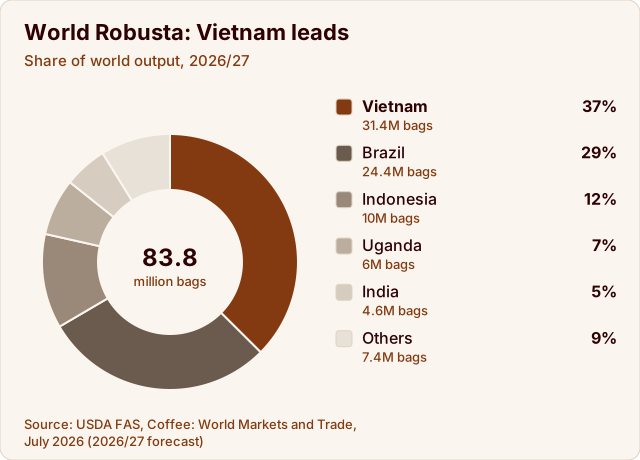
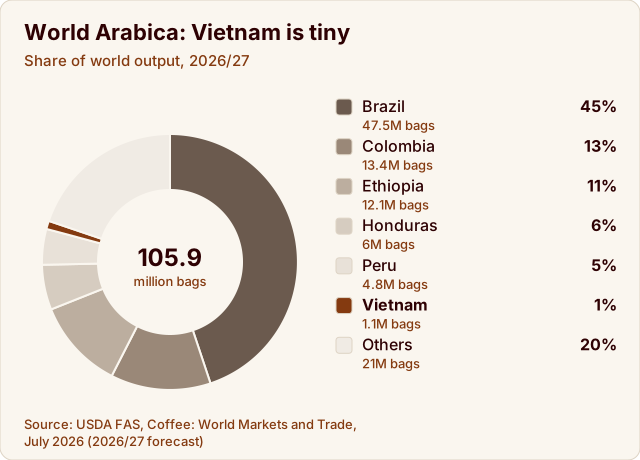
According to the US Department of Agriculture (USDA) July 2026 report, the world is forecast to harvest 189.7 million 60kg bags in 2026/27: 105.9 million bags of Arabica and 83.8 million bags of Robusta. Vietnam harvests 32.5 million bags, of which 31.4 million are Robusta and only 1.1 million Arabica. In other words, about 97 of every 100 bags of Vietnamese coffee are Robusta.
| Criterion | Vietnamese Robusta | Vietnamese Arabica |
|---|---|---|
| World position | Number 1, about 37% of production | About 1% of production |
| Exchange price | About 3,460 USD/tonne | About 6,450 USD/tonne |
| Taste | Bold and bitter, heavy body, low acidity | Bright acidity, aromatic, lighter body |
| Caffeine (green bean) | 1.6–2.4% | 0.9–1.2% |
| Drinks | Iced phin with milk, bạc xỉu, salt coffee, instant | Pour-over, cold brew, specialty espresso |
| Competes on | Volume, price, boldness | The distinct flavour of its growing region |
The two Vietnamese beans play on two different fields, so each needs looking at on its own.
Vietnamese Robusta: the world's number one
Price. Robusta is the cheaper bean on the market. On 14 October 2026, according to giacaphe.com, Robusta on the London exchange cost 3,459 USD/tonne, while Arabica on the New York exchange came to about 6,450 USD/tonne, almost twice as much. Central Highlands green coffee was about 93,000 VND/kg the same day. Because Vietnam sells the most Robusta, the London price moves with every weather report from the Central Highlands. Why prices are falling is in coffee prices fall as the new crop arrives.
Quality. Most Vietnamese Robusta is still sold as a mass commodity: strip-picked whole branches at a time, dried on open yards, graded by bean size and defect rate, then exported as raw beans. That is why the name "Vietnamese Robusta" is familiar to the world's roasters but unknown to its drinkers. In recent years some farms have moved to ripe picking, careful processing and "Fine Robusta". That story is told in Vietnamese coffee on the world map.
Taste. Robusta is more bitter, heavier in body and lower in acidity than Arabica, with notes usually described as dark chocolate, roasted nuts and wood. This is the taste Vietnamese people grew up with: a thick, sharply bitter phin that needs condensed milk to balance it. If you are not sure which taste suits you, the find your coffee quiz helps you find out.
Caffeine. According to a 2021 review in the journal Foods, by dry weight green Robusta beans contain about 1.6–2.4% caffeine, and Arabica about 0.9–1.2%. Robusta therefore has almost twice the caffeine. Caffeine adds to Robusta's bitterness, and is also why the Robusta plant is hardier: caffeine is the plant's defence against pests.
Drinks. Robusta is the base of almost the whole Vietnamese coffee menu: black phin, iced phin with milk, bạc xỉu, egg coffee and salt coffee. Its boldness holds up under condensed milk, ice, egg cream or salted cream, all of which would drown a light Arabica. Around the world, Robusta is the main ingredient of instant coffee, and is added to Italian-style espresso blends for a thicker crema and a bolder taste.
Competitiveness. Vietnam leads, but not alone. The main rivals, according to USDA's 2026/27 figures:
- Brazil (24.4 million bags). In Brazil, Robusta is called conilon. Brazil is both the largest Arabica producer and second in Robusta, with a very large home market, which makes it the toughest rival.
- Indonesia (10 million bags), mostly in South Sumatra and Java. This crop is down because heavy rain spoiled the flowering.
- Uganda (6 million bags), one of the places where Robusta grew wild before it was planted around the world, now setting production records.
- India (4.6 million bags), where Robusta is often grown under shade trees in the southern states.
Vietnam's advantages are high yields, large volume and competitive prices. Its weakness is that most of the value lies in roasting, packaging and branding, which usually happen in another country. For beans sold to Europe, being able to say which farm they came from is also becoming a requirement, as the EUDR explainer sets out.
Vietnamese Arabica: small, but with a place of its own
Price. Arabica costs almost twice as much as Robusta on the exchange, because the plant is harder to grow, needs cool highlands and yields less. Specialty Arabica, scored and sold lot by lot, is paid many times the exchange price. In this segment, price depends more on each lot's quality score than on New York.
Quality. Vietnamese Arabica is grown mainly in Lam Dong and in the northwest, such as Son La. According to Tạp chí Công Thương, Lam Dong has about 17,500 ha of Arabica, only around 10% of the province's coffee area, on plateaus 800–1,500m high. Cau Dat (Da Lat) is the best-known region, with two traditional Arabica varieties, Typica and Bourbon. The same source says the most widely planted variety is in fact Catimor, chosen for its yield and disease resistance, but rated lower for cup quality. So "Vietnamese Arabica" can mean a superb lot of Cau Dat Typica, or an ordinary bag of Catimor.
Taste. Arabica has clearer acidity, aroma and sweetness than Robusta, a lighter body and less bitterness. Cau Dat Arabica is usually gently acidic, fruity and sweet on the finish. Those are also the notes QiFi lists for TỈNH, our 100% Cau Dat Arabica.
Caffeine. About 0.9–1.2% in the green bean, roughly half that of Robusta, according to the same Foods review. People who sleep badly or get an uneasy stomach from coffee often find Arabica gentler, as coffee jitters and an upset stomach explains.
Drinks. Arabica shines when drunk almost as it is: pour-over, cold brew, specialty espresso, or a black coffee without sugar. Add a lot of condensed milk and ice and most of its aroma is hidden. How to brew to keep that aroma is in why coffee lovers swear by hand drip.
Competitiveness. In Arabica, Vietnam cannot compete on bags. Brazil produces 47.5 million bags, Colombia 13.4 million, Ethiopia 12.1 million, and Vietnam 1.1 million. Vietnamese Arabica competes on the distinct flavour of its growing region and on its home market: Vietnamese people drink more and more pour-over and cold brew, and they can buy Cau Dat Arabica without importing it.
Is Cau Dat Arabica better than African Arabica?
The straight answer: not better, different.
Ethiopia is the original home of the Arabica plant, with a great many local varieties that have no names of their own. Washed Ethiopian Arabica is usually described as floral, with a bright citrus acidity and a tea-like body. Kenyan Arabica is famous for a strong, clear acidity, often described as blackcurrant. These two origins are the benchmarks the specialty market compares against.
Cau Dat Arabica goes another way: gentler acidity, a rounder body, a sweet finish, fewer sharp floral notes. People who like a bright, floral cup will find Ethiopia or Kenya more exciting. People who like a balanced cup that is easy to drink every day may suit Cau Dat better.
And within each region, the gap between a good lot and an ordinary one is bigger than the gap between regions. The variety (Typica or Catimor), whether the cherries were picked ripe, washed or dry processing, and a dark or light roast decide the cup more than the region's name on the label.
The two beans in a Vietnamese cup
Robusta and Arabica are not rivals in a Vietnamese cup. Most phin blends sold in Vietnam mix the two: Robusta for boldness and body, Arabica for aroma and a little acidity. Culi, the cherries with a single round bean instead of two flat ones, is often added for a fuller taste. Each bean holds its own "voice" in the cup, as we describe in a taste for natural coffee and a healthy lifestyle. That taste is changing too: young drinkers take less sugar and are more curious about Arabica, according to how Gen Z and Millennials drink coffee.
At QiFi, NGUYÊN BẢN is mostly Robusta for those who like it bold and bitter, TỈNH is 100% Cau Dat Arabica for those who like bright acidity, and ĐỘC TÔN (Robusta, Culi and Arabica) sits between the two. All are naturally roasted, so what is in the cup is the taste of the bean, not of butter or flavourings.
Production figures from USDA, July 2026, forecast for 2026/27; prices from giacaphe.com on 14 October 2026; caffeine content from Olechno et al., Foods, 2021.
Frequently asked questions
Where does Vietnam rank in world coffee production?
Second in total production, after Brazil, and first in Robusta. In 2026/27, Vietnam is forecast to produce about 37% of the world's Robusta.
Is Robusta low-quality coffee?
No. Robusta and Arabica are two different species with two different kinds of taste. Robusta is seen as cheap because most of it is picked and dried in bulk. Picked ripe and processed carefully, Robusta makes a bold, sweet, clean cup.
Which has more caffeine, Arabica or Robusta?
Robusta. Green Robusta beans contain about 1.6–2.4% caffeine and Arabica about 0.9–1.2%, so Robusta has almost twice as much.
Where is Arabica grown in Vietnam?
Mainly in Lam Dong, best known at Cau Dat (Da Lat), and in the northwestern mountains such as Son La. Arabica makes up only about 3% of the country's coffee production.