Home brewing
Coffee grind size by brew method: phin, espresso, pour-over, cold brew
Espresso needs about 300 µm, filter coffee 770–1,115 µm, cold brew 500–900 µm. How to tell the grind is wrong, and how to choose one for a phin.
QiFi··6 min read
Contents
One bag of coffee, ground fine or coarse, gives two very different cups. The finer the grounds, the faster water pulls the flavour out, so every brew method needs a grind that matches how long the water stays in contact with the coffee. This article gathers the numbers measured in research, gives practical suggestions for phin, moka pot and French press, and shows how to tell when the grind is wrong. The examples use QiFi's lines: TỈNH for pour-over and cold brew, ĐẬM for the phin.
Why does grind size matter?
The finer the grounds, the larger the total surface in contact with water, and the faster the coffee dissolves. A study in Scientific Reports (Uman et al., 2016) found that small particles extract faster than large ones; the very fine sample in that study had 99% of its particles under 70 µm.
So the grind has to go with the brew time:
- Fast brews (espresso, about half a minute) need a fine grind to pull the flavour out in time.
- Slow brews (cold brew, several hours) need a coarse grind so the coffee is not over-extracted.
- In between sit filter coffee, phin and moka.
Finer is not always stronger. For espresso, a study in the journal Matter (Cameron et al., 2020) found that grinding too fine actually gave lower extraction, and that every shot came out differently.
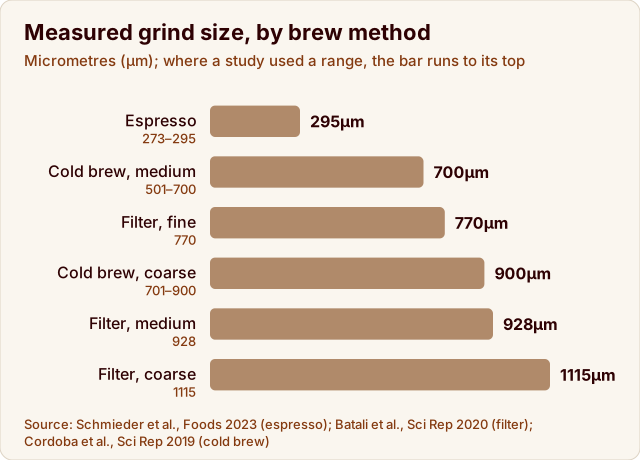
Grind sizes measured for each brew method
| Brew method | Particle size in the study | Source |
|---|---|---|
| Espresso | Around 273–295 µm on average | Schmieder et al., Foods, 2023 |
| Filter (pour-over, drip machine) | 770 µm (fine), 928 µm (medium), 1,115 µm (coarse) | Batali et al., Scientific Reports, 2020 |
| Cold brew | 501–700 µm (medium), 701–900 µm (coarse) | Cordoba et al., Scientific Reports, 2019 |
One µm (micrometre) is a thousandth of a millimetre: 1,000 µm is 1mm. These figures are the particle sizes in each study, not a shared standard; every grinder turns out its own mix of coarse and fine particles.
Batali's study also cites the markers of the filter brewing chart that the Specialty Coffee Association (SCA) uses: a balanced filter cup has total dissolved solids (TDS) of about 1.15–1.35% and an extraction of about 18–22%. The article on coffee-to-water ratios for hand brewing has a tool for calculating coffee and water for filter coffee.
Phin, moka pot, French press: practical suggestions
We could not find any study that measured particle size for phin, moka pot or French press. The table below is a set of practical suggestions, compared against the measured figures above, not measured data:
| Brew method | Suggested grind | What it looks and feels like |
|---|---|---|
| Espresso | Fine | Almost like flour, clumps when you press it |
| Moka pot | Medium-fine, a little coarser than espresso | Like fine sand |
| Phin | Medium to slightly fine | Like granulated sugar, not flour |
| Pour-over, V60 | Medium | Like coarse sand |
| French press | Coarse | Like rock salt |
| Cold brew | Coarse | Like rock salt, or coarser |
The phin is a special case because it works by gravity and a press plate: ground too fine, the water will not run or takes very long, and the cup is harsh and bitter; ground too coarse, the water runs straight through in the first few minutes and the cup is thin. The standard timing and how to adjust it are in brewing phin coffee the right way. For moka, see moka pot coffee at home; for cold brew, cold brew at home.
What does a wrong grind taste like?
| Symptom | Likely cause | What to change |
|---|---|---|
| The phin drips for too long, the cup is bitter and harsh | Ground too fine | Grind one step coarser, or press more gently |
| The phin runs straight through, the cup is thin and sour | Ground too coarse | Grind one step finer |
| Espresso runs far too fast, thin and watery | Ground too coarse | Grind finer |
| Espresso runs slowly, sometimes spritzes, and tastes different each time | Possibly ground too fine | Grind a little coarser, tamp evenly |
| French press leaves sludge at the bottom of the cup | Ground too fine | Grind coarser, pour gently and leave the last part behind |
| Cold brew is cloudy and bitter | Ground too fine | Grind coarser, filter it more carefully |
Change one thing at a time: keep the dose, the water and the temperature the same, change only the grind, and taste again.
Blade grinder or burr grinder?
We could not find a scientific study comparing the two. In a 2020 test by Coffee Review, a coffee-review site inside the industry, coffee ground on four burr grinders and on a blade grinder was sent off for laser particle-size measurement. The blade grinder produced the most uneven particles. The more even the particles, the easier it is to control the flow of water through the coffee, so the article recommends a burr grinder; even so, a blade grinder is still better than buying coffee pre-ground.
If a blade grinder is all you have: grind in short bursts, shake the grinder between bursts, and use it for forgiving methods such as the phin or cold brew rather than espresso.
Grind fresh, or buy it ground?
Ground coffee loses its aroma far faster than whole beans. According to the SCA, the CO₂ that whole beans lose over a few weeks is lost by ground coffee in a few minutes, and the aroma goes with it.
- With a grinder: buy whole beans and grind them just before brewing.
- Without a grinder: buy coffee ground for the way you brew, in a small bag you will finish within a few weeks, and keep it sealed. How to store it is in storing coffee.
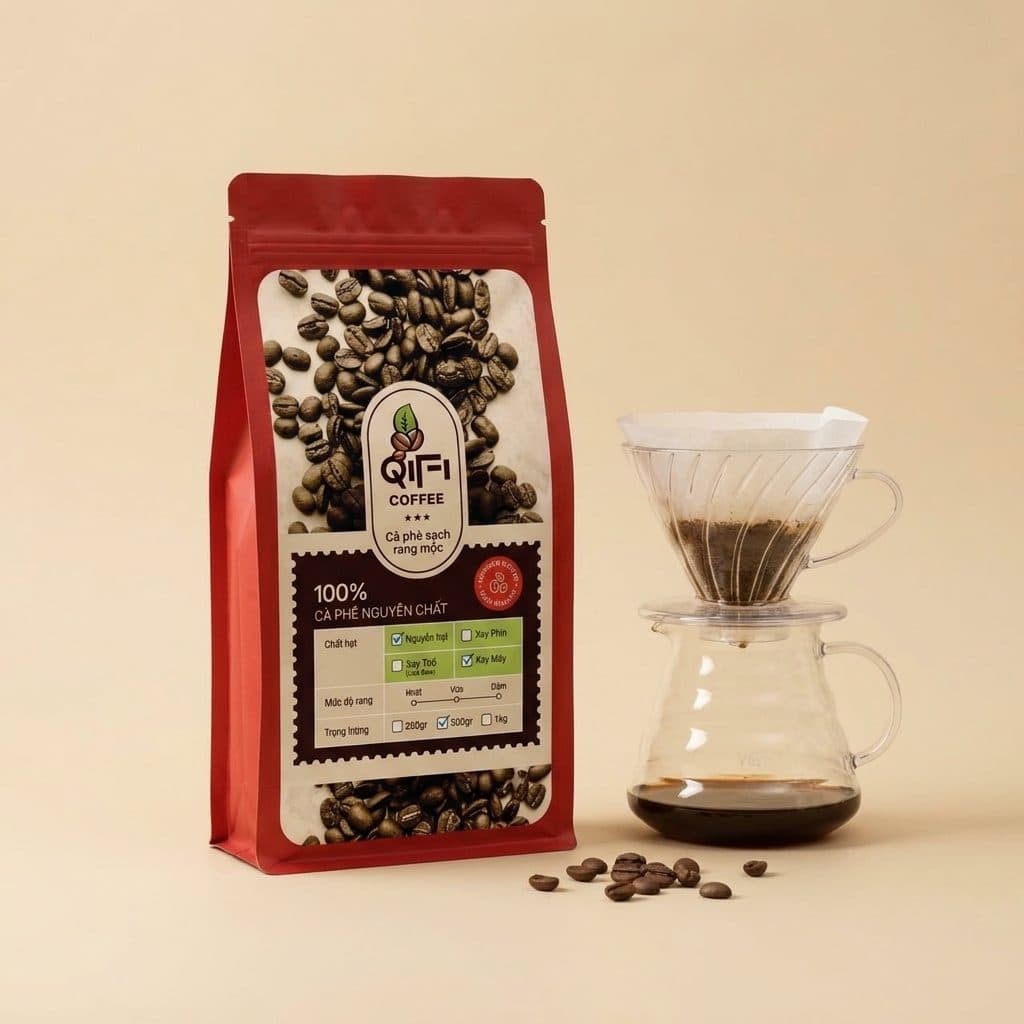
Every QiFi line comes whole or ground for a particular method: phin, espresso, coarse for cold brew, medium for pour-over. The bag has a one-way valve to let gas out without letting air in.
Which QiFi coffee, ground how?
| QiFi line | What is in it | Brew methods and grind that suit it |
|---|---|---|
| ĐẬM | 100% Robusta | Phin grind for the phin and iced milk coffee; espresso grind for a machine |
| ĐÁNH THỨC | Robusta and Arabica | Phin grind; medium for pour-over; coarse for cold brew |
| TỈNH | 100% Arabica | Coarse for cold brew; medium for pour-over; espresso grind for a bright, fruity shot |
Frequently asked questions
What grind should phin coffee be?
Medium to slightly fine, the size of granulated sugar, not flour. No study has measured particle size for the phin; the way to check is the flow: if the phin drips for too long, grind coarser, if it runs straight through, grind finer.
Can I brew espresso with coffee ground for a phin?
Usually not well. Espresso needs much finer particles, around 300 µm according to the study cited above; phin grind makes the water run far too fast and the shot thin. When you buy, choose the espresso grind.
Does a finer grind always make stronger coffee?
Not necessarily. Fine particles extract faster, but with espresso, grinding too fine lowers extraction again and makes every shot different, according to the study in Matter. The right grind is the one that suits the brew method.
How coarse should cold brew be ground?
Cordoba et al. (2019) used two levels: medium at 501–700 µm and coarse at 701–900 µm. At home, the size of rock salt is the easiest marker to aim for.