Home brewing
Coffee-to-water ratios for hand brewing: strong without the harsh bitterness
The coffee-to-water ratio decides whether a cup is strong or weak, harsh or sweet. How to choose and adjust it for phin, pour-over and cold brew at home.
QiFi··Updated ·6 min read
Contents
"Too strong and it's bitter, too weak and it's coloured water." This is the most common complaint from people who start brewing coffee at home. The culprit is usually not the beans but the coffee-to-water ratio and how the coffee is extracted.
This article explains why the ratio matters, which numbers baristas use to measure a "good" cup, the starting ratios for each brewing method, and how to adjust so the cup is strong without being harsh.
Strong and bitter are two different things
Many people think the stronger the coffee, the more bitter it is. In fact these are two separate properties:
- Strength: how much dissolved coffee is in the cup, which decides whether it feels "thick" or "thin". You adjust it mainly with the ratio.
- Extraction: what percentage of the grounds' mass the water has pulled out, which decides whether the cup tastes sour, sweet or harsh and bitter. You adjust it with grind size, temperature and time.
A harsh, bitter cup is usually over-extracted: grounds too fine, water too hot or a steep too long pulls out the bitter, astringent compounds. To make it stronger without the harshness, add more coffee rather than steeping longer.
How do baristas measure a "good" cup?
Both properties can be measured, and the coffee industry has used them since the 1950s in a chart called the Brewing Control Chart:
- TDS (total dissolved solids) measures strength: the percentage by mass of coffee in the cup. A TDS of 1.25% means 100g of brewed coffee contains 1.25g of coffee solids.
- PE (percent extraction) measures extraction: the percentage of the grounds' mass that dissolved into the water.
According to a University of California, Davis study published in Scientific Reports in 2020, the "ideal" box on this classic chart is a TDS of 1.15–1.35% and a PE of 18–22%. The chart divides cups into zones around that box:
| Zone | Strength (TDS) | Extraction (PE) | Typical taste | What to adjust |
|---|---|---|---|---|
| Ideal | 1.15–1.35% | 18–22% | Balanced, sweet finish | Keep the recipe |
| Weak, under-extracted | Low | Below 18% | Thin, sharply sour | More coffee, finer grind |
| Strong, under-extracted | High | Below 18% | Dense but sour, lacking sweetness | Finer grind, same ratio |
| Weak, over-extracted | Low | Above 22% | Watery yet bitter | More coffee, coarser grind |
| Strong, over-extracted | High | Above 22% | Heavy, harsh, drying | Coarser grind, cooler water |
You do not need a TDS meter at home. What is worth remembering is that the ratio mostly moves a cup along the strong–weak axis, while grind and time move it along the under–over-extracted axis. Once you know which way your cup leans, you know which dial to turn.
This ideal box was built for Western-style filter coffee drunk black. The Vietnamese phin deliberately sits outside it: phin coffee is much stronger because it is meant to be mixed with ice or milk.
Standard starting ratios
| Method | Suggested ratio | Example |
|---|---|---|
| Traditional phin | about 1:4 | 20g of coffee, 80ml of water |
| Pour-over | 1:15–1:17 | 15g of coffee, 240ml of water |
| French press | 1:12–1:15 | 20g of coffee, 280ml of water |
| Cold brew (concentrate) | 1:10 | 100g of coffee, 1 litre of water, 12 hours |
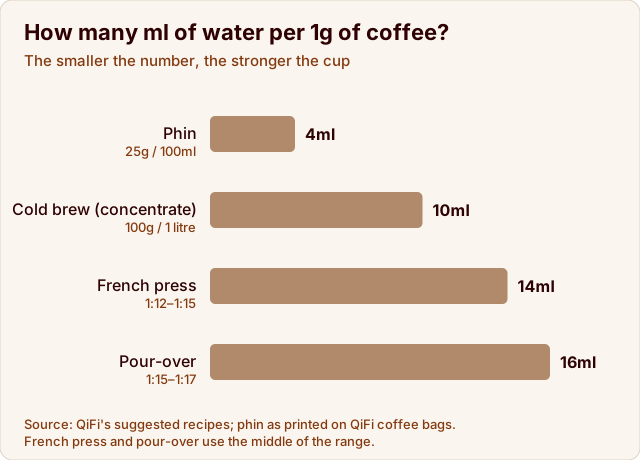
These are starting points, not rules. Everyone's taste is different; the goal is to find your ratio and then keep it consistent.
Water temperature matters less than you think
The same UC Davis study had tasters try coffee brewed at 87°C, 90°C and 93°C. The result: when strength and extraction were held equal, temperature made almost no difference to the taste the tasters perceived. Temperature matters mainly because it makes water extract faster or slower, so it changes extraction indirectly.
The lesson for home brewing: do not fuss over every degree. Water brought to the boil and rested for 30–60 seconds, about 92–96°C, is enough. If a cup is harsh, adjust the grind first and only then think about temperature.
How to adjust the ratio by taste
Brew a cup at the standard ratio, taste it, then adjust according to the cases below. Change only one thing at a time.
If the coffee is weak and thin: add 1–2g of coffee (pour-over) or 2–3g (phin) and keep the water the same.
If the coffee is strong but harsh and astringent: keep the ratio, but grind one step coarser or lower the water temperature by 2–3°C. Harsh bitterness is a sign of over-extraction, not of too little water.
If the coffee is sharply sour and lacks sweetness: it is usually under-extracted. Grind slightly finer or pour more slowly.
If the coffee is both strong and sweet on the finish: write the recipe down. You have found the balance point.
Ratios for iced phin and milk coffee
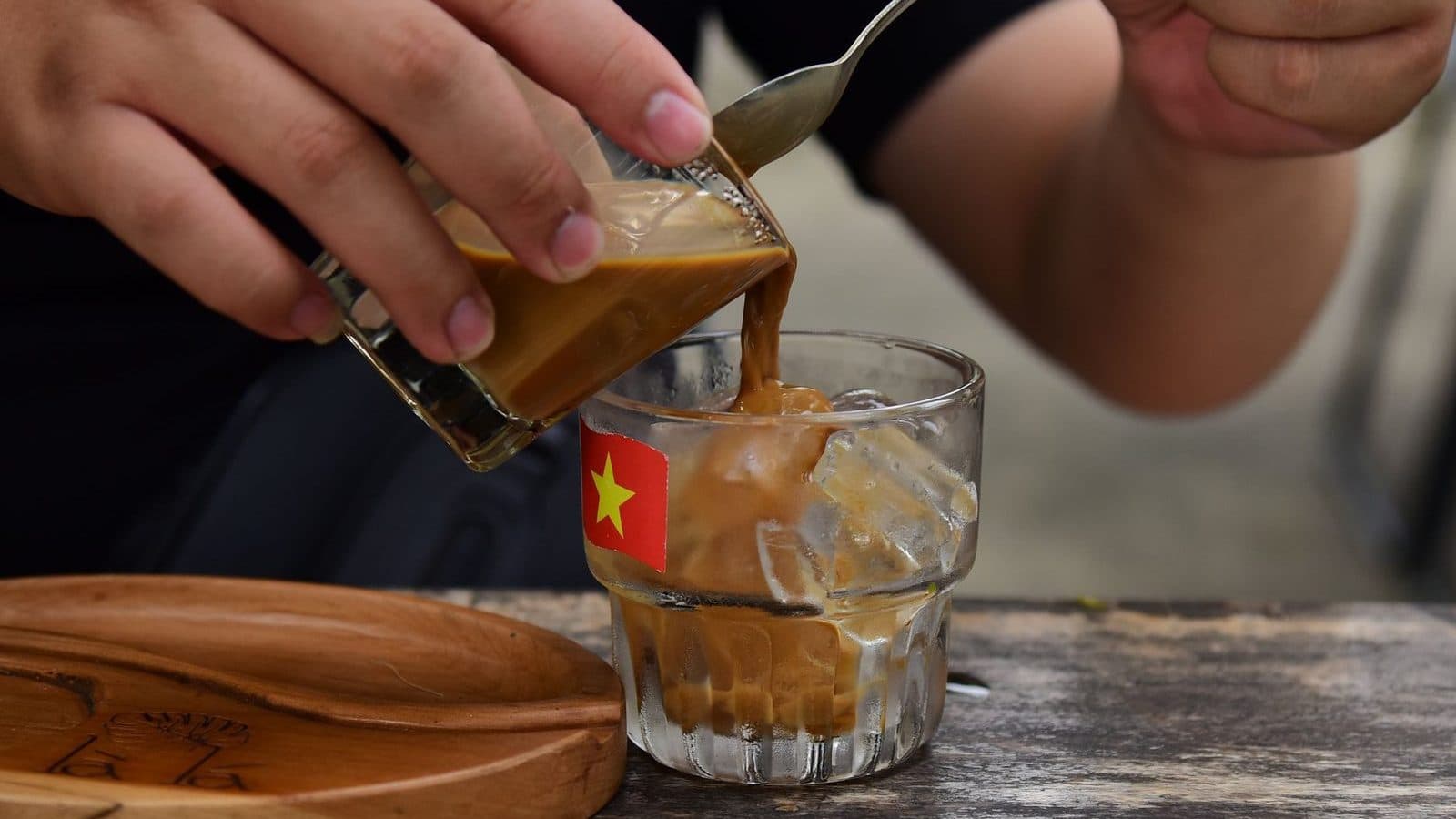
Melting ice dilutes the coffee, so for iced phin keep a strong ratio (20g for about 80ml of water) and pour it straight over a full glass of ice. With milk coffee, condensed milk masks some of the bitterness, so a strong, Robusta-heavy blend such as ĐÁNH THỨC (Robusta and Arabica) or NGUYÊN BẢN (Robusta and Arabica) keeps a clear coffee taste without being drowned by the milk.
A glass of salt coffee uses exactly this phin ratio, scaled down: 20g of coffee to 80ml of water, because the cream and ice will dilute the glass.
Ratios for cold brew
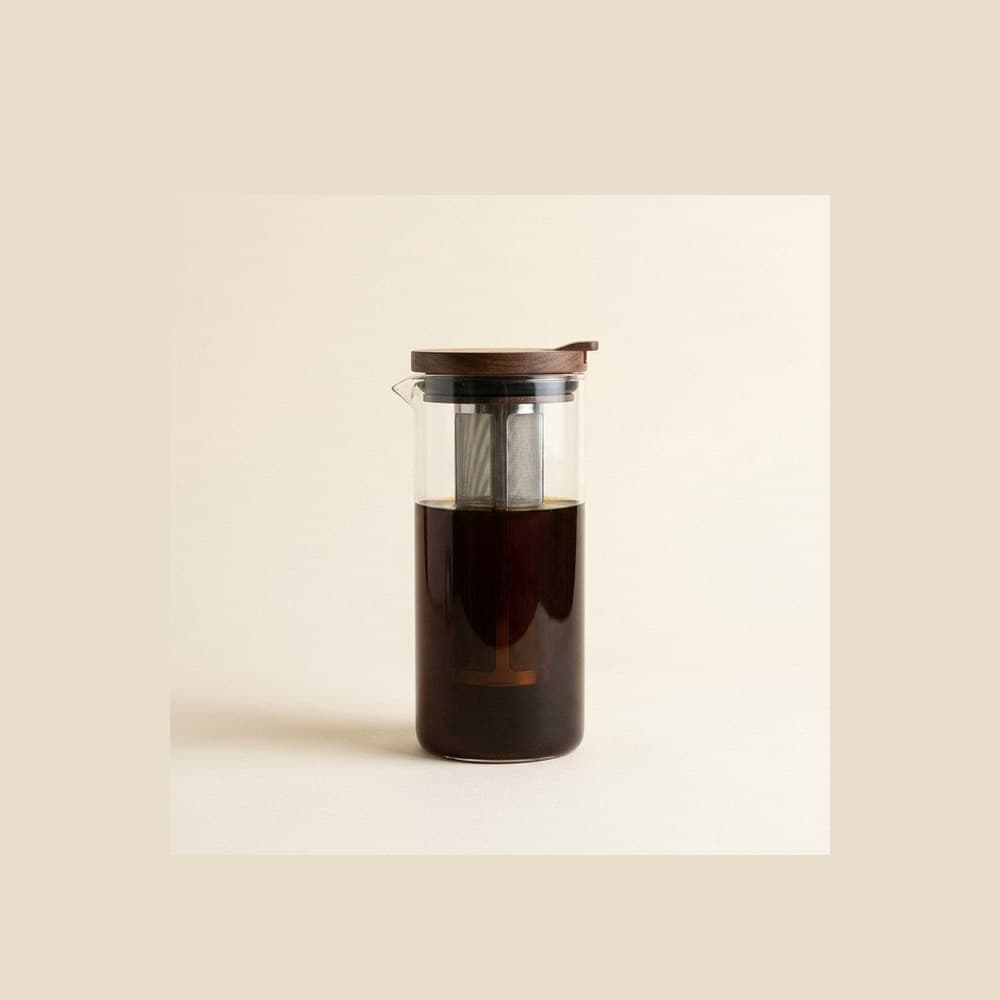
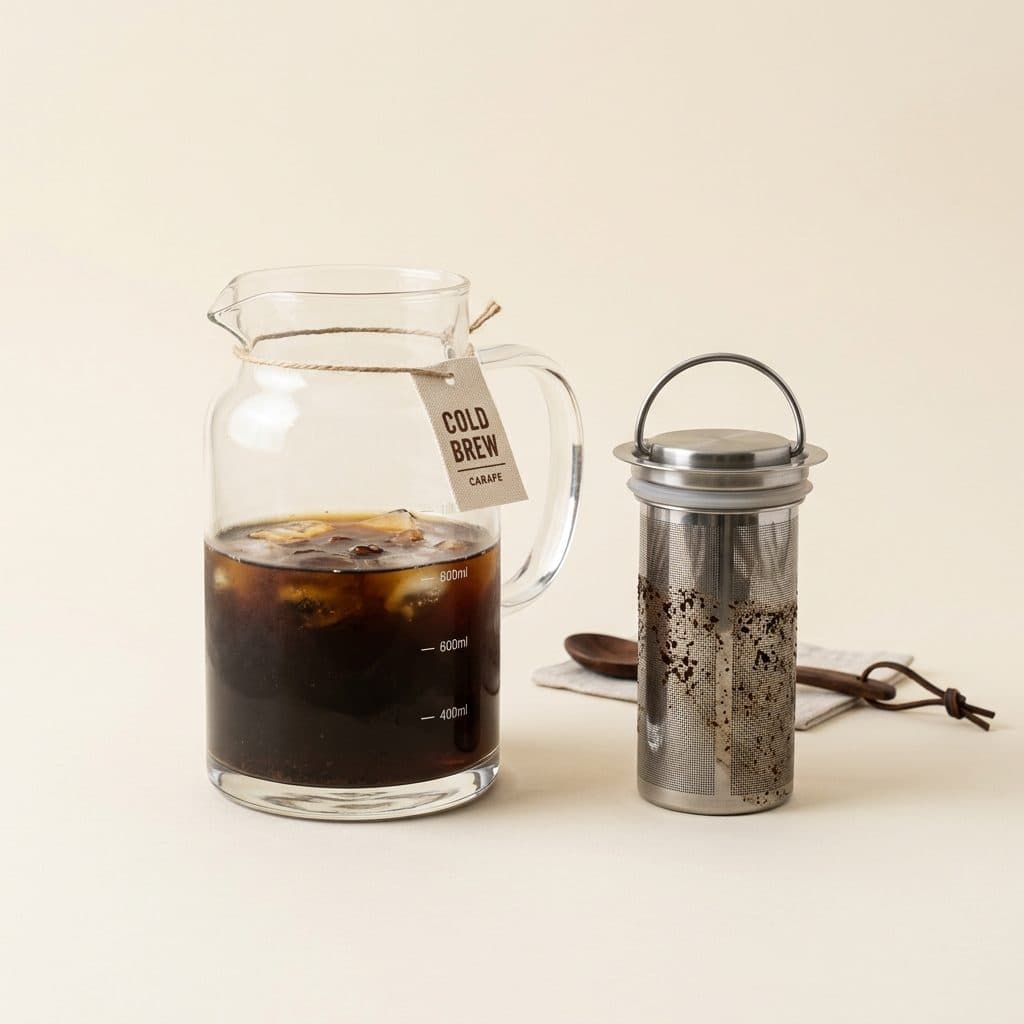
Cold brew is extracted with cool water over a long time, so it has very little harsh bitterness. QiFi's recipe: 100g of coarsely ground coffee to 1 litre of water, steeped for about 12 hours in the fridge, then strained. The concentrate can be diluted 1:1 with water or milk to taste. The QiFi cold brew bottle has a built-in filter, which keeps steeping and straining tidy.
Bean quality sets the limit
The right ratio lets good beans show everything they have, but it cannot rescue poor beans. Coffee bulked with soybeans, coated in butter or flavourings usually tastes burnt and bitter whatever the ratio. Pure, naturally roasted coffee gives you a clean base to experiment with.
Small tips for a consistent ratio
- Use a scale, not a spoon. The same spoonful of dark-roasted beans weighs less than one of light-roasted beans.
- Weigh the water too; do not guess by eye. A digital scale is the best buy in a hand-brewing toolkit.
- Grind just before brewing. Pre-ground coffee loses its aroma quickly, which makes you think you need more coffee.
- Keep notes each time so you can repeat a good cup.
For the full picture, read how to brew coffee by hand like a barista at home. If the ratio is right and the cup still is not, go through 5 mistakes when brewing coffee by hand.
Frequently asked questions
Is the 1:4 phin ratio too strong?
A phin makes a small, strong concentrate that is usually drunk with ice or milk. If you drink it hot and black, you can add hot water after brewing to lighten the cup without making it bitter.
Should I steep longer to make the coffee stronger?
No. Steeping longer pulls out more harsh bitterness. To make it stronger, add more coffee.
Do I need to buy a TDS meter?
No. A TDS meter is useful for cafés and for people who want to compare recipes precisely. At home, a digital scale and your own taste are enough: if it is weak, add coffee; if it is harsh, grind coarser.